Young and Damned and Fair: The Life of Catherine Howard, Fifth Wife of King Henry VIII by Gareth Russell
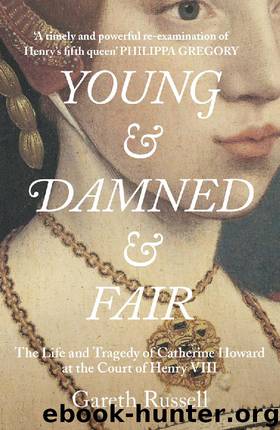
Author:Gareth Russell [Russell, Gareth]
Language: eng
Format: epub
Tags: History, Biography
ISBN: 9781501108648
Google: EmlODQEACAAJ
Goodreads: 29430787
Publisher: Simon & Schuster
Published: 2016-11-01T08:00:00+00:00
Chapter 16
The Girl in the Silver Dress
O, you wake then! come away,
Times be short, are made for play;
The humorous moon too will not stay …
– Ben Jonson, Oberon, the Faery Prince: A Masque (1611)
On 7 July 1541, while she was still at Dunstable, Catherine received a new title when heralds at Greenwich proclaimed her the first queen consort of Ireland.1 The Irish Parliament had been summoned in spring, met from 13 June to 20 July, and its first statute was a proposal to change Henry’s title from lord to King of Ireland. The bilingual Earl of Ormond translated the relevant speeches into Irish, to the ‘contention’ of fellow lords who did not speak English, and the motion was ‘joyously agreed to by both Houses’.2 Those hearing the news on the streets of Dublin could not have been more emphatically supportive. Prisoners were pardoned; the council dispensed free wine to the revellers who danced and lit bonfires in the streets; Dubliners organised celebratory feasts in their homes, and two thousand people attended a thanksgiving Mass at St Patrick’s Cathedral.3 The kings of England had been styled lords of Ireland for the last three centuries since the reign of Henry II, when his intervention after a series of local disputes culminated with him being acknowledged as overlord by Ireland’s local kings and chieftains, and the apparent blessing of the papacy.4
The Irish Parliament wanted to use the Crown of Ireland Act to fix a plethora of problems facing their country, and while many foreigners, and historians, assumed that the kingly elevation in Ireland was Henry’s idea, it was an initiative born in Dublin. In his capacity as Lord of Ireland, Henry had ruled on the vicious side of indifference – when he did involve himself in the island’s issues, it was seldom pleasant. The first reason for proposing a change in his title was that a king had a certain set of expected responsibilities, far more clearly defined than a lord’s and, as king, Henry would be expected to work harder at the island’s good government.
It was also quite clear to everyone in sixteenth-century Dublin that the country could not prosper if the Crown’s authority was obeyed by some Irishmen and ignored by others. Everyone who interacted with Irish politics and possessed a modicum of intelligence could see that the country was in urgent need of reform. The Duke of Norfolk, who had been the king’s Viceroy for Ireland from 1519 to 1523, and later Thomas Cromwell had both put forward plans for an overhaul of the system.5
The Irish Council had an ambitious programme to accompany the act, which included bringing the estranged Gaelic nobility into the fold by granting them titles in the Anglo-Irish peerage while confirming their ancestral grants of land or making new ones. Through a process of assimilation, the Irish Parliament hoped to neutralise the tensions, and threats of rebellion, that had plagued the island and dominated the Irish aristocracy. A representative of the Irish Privy Council told his
Download
This site does not store any files on its server. We only index and link to content provided by other sites. Please contact the content providers to delete copyright contents if any and email us, we'll remove relevant links or contents immediately.
We're Going to Need More Wine by Gabrielle Union(19050)
Pimp by Iceberg Slim(14514)
Bombshells: Glamour Girls of a Lifetime by Sullivan Steve(14078)
The Radium Girls by Kate Moore(12033)
Becoming by Michelle Obama(10030)
Educated by Tara Westover(8056)
The Girl Without a Voice by Casey Watson(7890)
Wiseguy by Nicholas Pileggi(5790)
Hitman by Howie Carr(5099)
The Wind in My Hair by Masih Alinejad(5097)
The Rules Do Not Apply by Ariel Levy(4971)
Hunger by Roxane Gay(4929)
On the Front Line with the Women Who Fight Back by Stacey Dooley(4874)
Year of Yes by Shonda Rhimes(4760)
The Borden Murders by Sarah Miller(4328)
Papillon (English) by Henri Charrière(4277)
Joan of Arc by Mary Gordon(4116)
American Kingpin by Nick Bilton(3891)
Patti Smith by Just Kids(3779)
